The latest
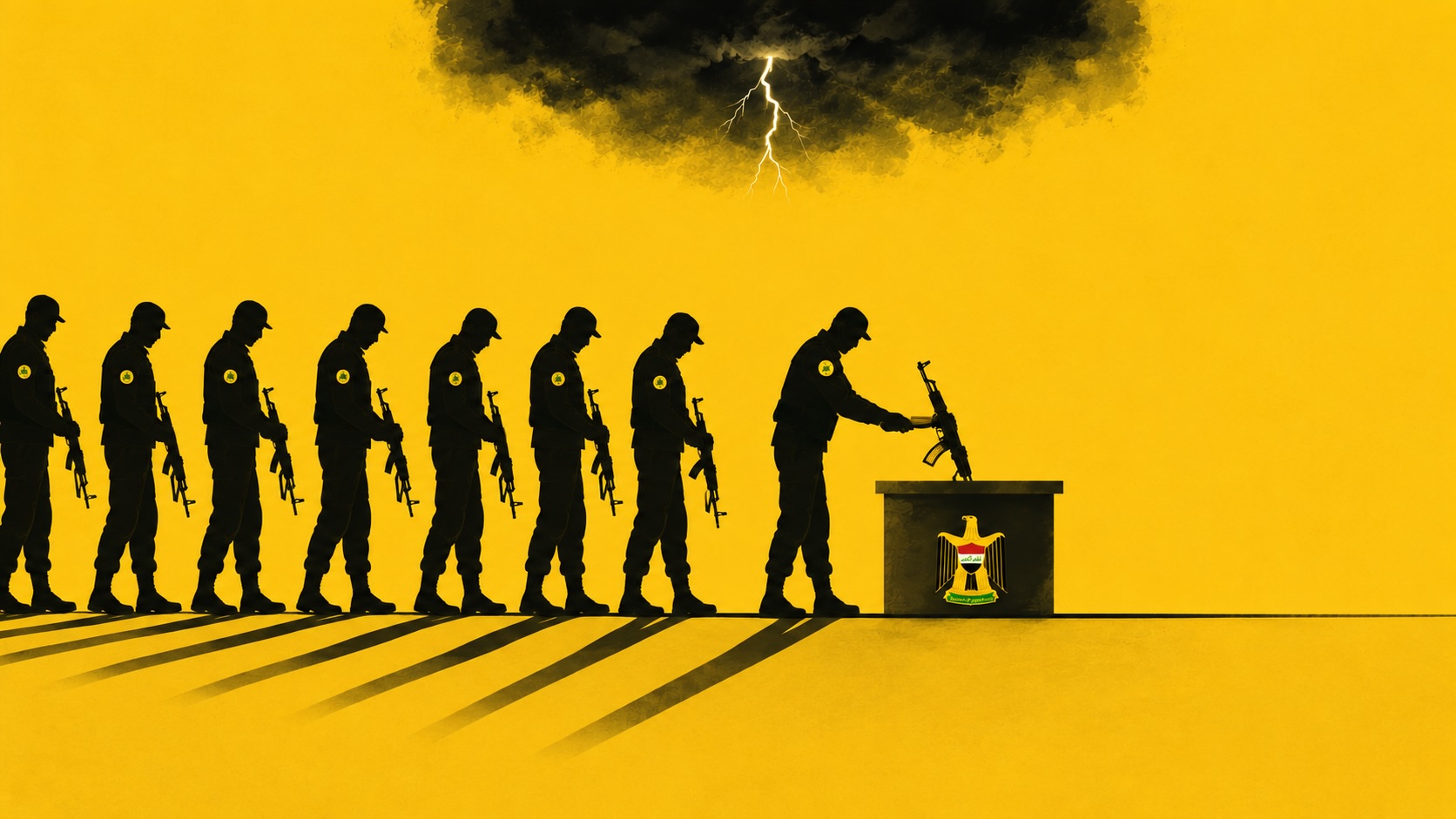
Iraq’s political center is moving toward a clearer position: weapons should be held by the state.
That shift is happening under direct U.S. pressure and after Prime Minister Ali al-Zaidi was given the mandate to manage the file inside the Shiite political house.
In that context, Asaib Ahl al-Haq, led by Qais al-Khazali, announced the formation of a central committee to complete its separation from the Popular Mobilization Forces. The committee is supposed to inventory personnel, weapons, vehicles, equipment and logistics in line with the “requirements of the state and its security institutions.” The movement said the decision falls under the broader path of restricting weapons to the state and linking armed structures to the commander in chief.
According to +ontime sources, Kataib Sayyid al-Shuhada has also entered the same path, as part of a wider repositioning wave involving Iran-aligned factions in Iraq, including Kataib al-Imam Ali.
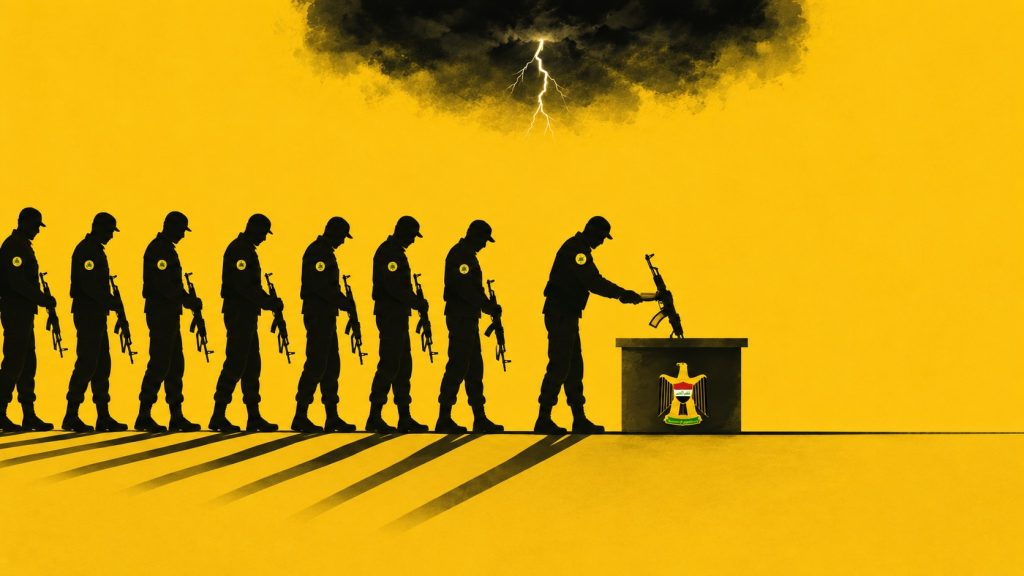
But these steps do not yet amount to real disarmament. They look more like the start of a long maneuver: the factions are lowering their heads before the storm, trying to absorb U.S. pressure without surrendering the deeper networks that gave them power inside the state and the economy.
Details
• Asaib’s announcement is the clearest so far. The group referred to an official committee, an inventory of weapons and vehicles, and an organizational separation from the PMF.
• The political message matters more than the administrative details. The faction is signaling that it will not openly confront the state’s decision to monopolize weapons.
• ontime+ sources say Kataib Sayyid al-Shuhada has entered the same track, but with a different level of caution and public visibility.
• Its inclusion matters because the faction is one of the groups most closely tied to the IRGC’s regional agenda and cross-border operations.
• That makes the move look less like an ideological shift and more like a repackaging of influence.
• Washington is pressing Baghdad to reduce the role of Iran-linked factions inside the state, not just on the streets.
• The pressure is not only political. In May, the U.S. Treasury sanctioned officials, companies and figures it said had exploited Iraq’s oil sector for the benefit of Iran and its proxies. The designations included figures linked to Asaib Ahl al-Haq and Kataib Sayyid al-Shuhada.
Who are these factions?
Asaib Ahl al-Haq
Asaib Ahl al-Haq is the most visible faction in this wave.
It is led by Qais al-Khazali, with his brother Laith al-Khazali seen as an influential figure in the background. Qais moved over the years from militia commander to political player inside the Shiite power structure.
The movement has a political wing, Sadiqoun, and a presence in parliament and state institutions. Washington designates Asaib Ahl al-Haq as a terrorist organization and views it as part of Iraq’s Iran-aligned militia network.
The group has built political and economic influence, using its position inside state institutions to expand its reach. That means a formal split from the PMF would not automatically dismantle its networks inside ministries, contracts and economic offices.
Kataib al-Imam Ali
Kataib al-Imam Ali is closely associated with Shibl al-Zaidi, one of the faction’s best-known figures.
The group combines armed activity with social, political and economic reach. It has also placed strong emphasis on building commercial influence.
That matters because a group with this type of footprint does not lose its power simply by changing its military label. The flag can change while the business networks remain.
Kataib Sayyid al-Shuhada
Kataib Sayyid al-Shuhada is led by Abu Alaa al-Walai, whose name is Hashim Finyan Rahim al-Saraji.
The faction emerged from an environment close to Kataib Hezbollah. It became linked to the war in Syria and to Iran’s regional agenda. It operates as a cross-border faction aligned with the IRGC and the so-called “resistance” axis.
For that reason, its entry into the separation track, according to our sources, does not remove doubts. It does the opposite. It makes the move look like part of a wider tactic: bending to the storm, not leaving the system.
Why it looks like a maneuver
Iran-linked groups in Iraq have developed major funding channels inside the energy sector. These include fuel smuggling and the exploitation of subsidized products, with revenues estimated in the billions of dollars annually.
The factions may hand over part of their weapons, or move their brigades into a more official structure. But they can still keep what may matter more: money, contracts, protection networks, commercial fronts and influence inside institutions.
This path of maneuvering is likely long and coordinated with the IRGC. The factions understand that the phase has changed. U.S. pressure is now direct. The Iraqi government needs to show that it controls the weapons file. The Shiite political camp wants to avoid a broad internal clash.
So the factions are choosing the gray zone: separation statements, inventory committees, legal language and perhaps the handover of some heavy or medium weapons.
But the core of their power may remain somewhere else.
What to watch
The real test is not the separation statements. It is in three files:
Will heavy and medium weapons actually be handed over to the state?
Will economic offices, collection networks and extortion channels be shut down?
Will these factions be prevented from converting military power into safer government and economic influence?
If not, Iraq will be facing repositioning, not disarmament.
Source: